
Why Resilient Health Is Different — And Why It Works
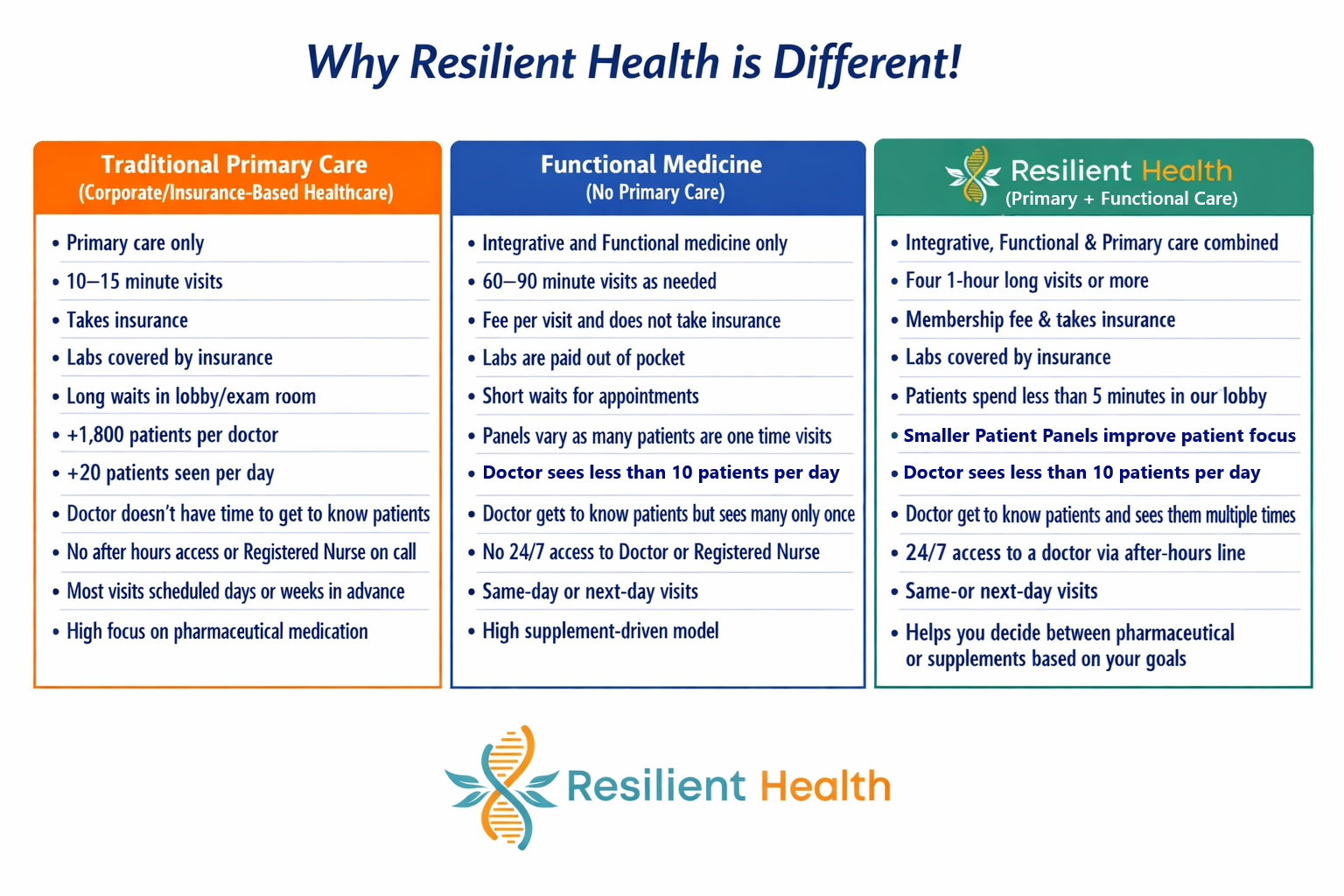
Most people have experienced the traditional healthcare system: rushed visits, long waits, and a sense that the doctor is trying to move on to the next patient before truly understanding what’s going on. Others have tried functional medicine clinics that offer longer visits but don’t provide primary care, don’t take insurance, and often rely heavily on supplements.
Resilient Health was built to solve both problems at once — and to give patients something they rarely experience in modern medicine: time, access, and a doctor who actually knows them.
Below is a breakdown of what makes Resilient Health fundamentally different:
1. A Truly Integrated Approach to Medicine
Most clinics force you to choose between:
Traditional primary care, which is fast but shallow
Functional or integrative medicine, which is thorough but expensive and disconnected from insurance
Resilient Health combines the best of all three worlds:
Integrative + Functional + Primary Care — Together
Your care includes:
Root-cause investigation
Whole-person health strategies
Preventive and primary care
Insurance-covered labs
A doctor who can treat acute issues and long-term wellness
This means you don’t have to bounce between multiple clinics or pay out-of-pocket for every visit. You get a single physician who understands your full medical picture and works with you on your goals.
2. Longer Appointments That Actually Allow Real Medicine
Most primary care visits last 10–15 minutes. That’s barely enough time to describe your symptoms, let alone understand them.
At Resilient Health, patients receive:
Four 1-hour visits or more each year
Additional time as needed
Space for real conversations, real questions, and real problem-solving
When doctors have time, they don’t guess. They don’t rush. They don’t default to prescriptions because they’re out of time. They practice medicine the way it was meant to be practiced.
3. Faster Appointments and Minimal Waiting
Patients often spend more time in the waiting room than with their doctor. Not here.
At Resilient Health:
Patients spend less than 5 minutes in the lobby
Visits start on time
Same-day or next-day appointments are standard
No crowded waiting rooms, no overbooked schedules
Your time is respected — because your health deserves more than a rushed, assembly-line experience.
4. A Smaller Patient Panel Means You’re Actually Known
Traditional primary care doctors often manage 1,800–2,500 patients. It’s impossible to build meaningful relationships at that scale.
Resilient Health limits each doctor to approximately 200 patients.
This changes everything:
Your doctor remembers you
They understand your history
They see you multiple times per year
They can follow your progress and adjust your plan
You’re not “a chart” — you’re a person
This is the foundation of concierge medicine, but with the added benefit of insurance integration and functional medicine depth.
5. 24/7 Access to a Doctor Who Knows You
Health doesn’t follow business hours. That’s why Resilient Health provides:
24/7 access to a doctor via an after-hours line
Direct communication when you need it
No urgent care roulette
No explaining your history to a stranger
When something feels off, you can reach out immediately — and talk to someone who already understands your health.
6. A Focus on Your Goals — Not Pushing Prescriptions
Traditional clinics often rely heavily on pharmaceuticals because:
Visits are short
Doctors don’t have time to explore alternatives
Insurance reimbursement rewards speed, not depth
Resilient Health takes a different approach:
Medications are used when appropriate
Supplements are used when appropriate
The choice is based on your goals, not convenience
You’re part of the decision-making process
This is medicine that respects your preferences, your lifestyle, and your long-term health.
The Bottom Line
Resilient Health isn’t just another clinic. It’s a rethinking of what healthcare should feel like:
More time
More access
More understanding
More partnership
More alignment with your goals
And far less of the rushed, impersonal, insurance-driven experience patients have come to expect.
If you want healthcare that feels human again — healthcare that sees you, hears you, and works with you — this is what Resilient Health was built for.