
Ferritin Levels and Iron Deficiency: What the New 2026 ASH Guidelines Mean
Your hemoglobin is normal, your serum iron is normal, and nothing on your lab report is flagged. Your ferritin is 22.
Under the 2026 guidelines from the American Society of Hematology (ASH), that ferritin result can indicate iron deficiency, even when every line of the report reads as normal. This post explains what changed, why ferritin carries so much weight, and what to bring to your next conversation about your bloodwork.
Key Takeaways
ASH's 2026 guideline raises the ferritin threshold for diagnosing iron deficiency in most adults from ≤15 ng/mL to ≤30 ng/mL.
For people with symptoms or higher-risk situations, such as heavy menstrual bleeding or pregnancy with anemia, ≤50 ng/mL may be appropriate.
Iron deficiency can be present with a normal hemoglobin. Anemia is a later stage of the process, so a normal hemoglobin does not rule out low iron stores.
Serum iron, ferritin, hemoglobin, and transferrin saturation each answer a different question, so one “normal” result can be misleading.
When inflammation is present, ferritin can look falsely reassuring, which is why ASH pairs it with transferrin saturation (TSAT).
2026 Update From The American Society of Hematology
In September 2026, ASH published new guidelines on the diagnosis of iron deficiency in Blood Advances. For adults, ASH now suggests ≤30 ng/mL, rather than ≤15 ng/mL, as the diagnostic threshold for ferritin. For people with symptoms or ongoing risk factors, ≤50 ng/mL may be appropriate.
The update responds to a real gap. ASH estimates that iron deficiency affects about 10 million adults in the United States and 2 billion people worldwide, and that up to 70% of cases may be missed in high-risk groups because of limited screening and inconsistent reference ranges.
What Changed in the New ASH Iron Deficiency Guidelines?
The guideline sets thresholds for several groups, including adults, young children, menstruating and pregnant people, and people with inflammation. Here is how the main adult categories compare.
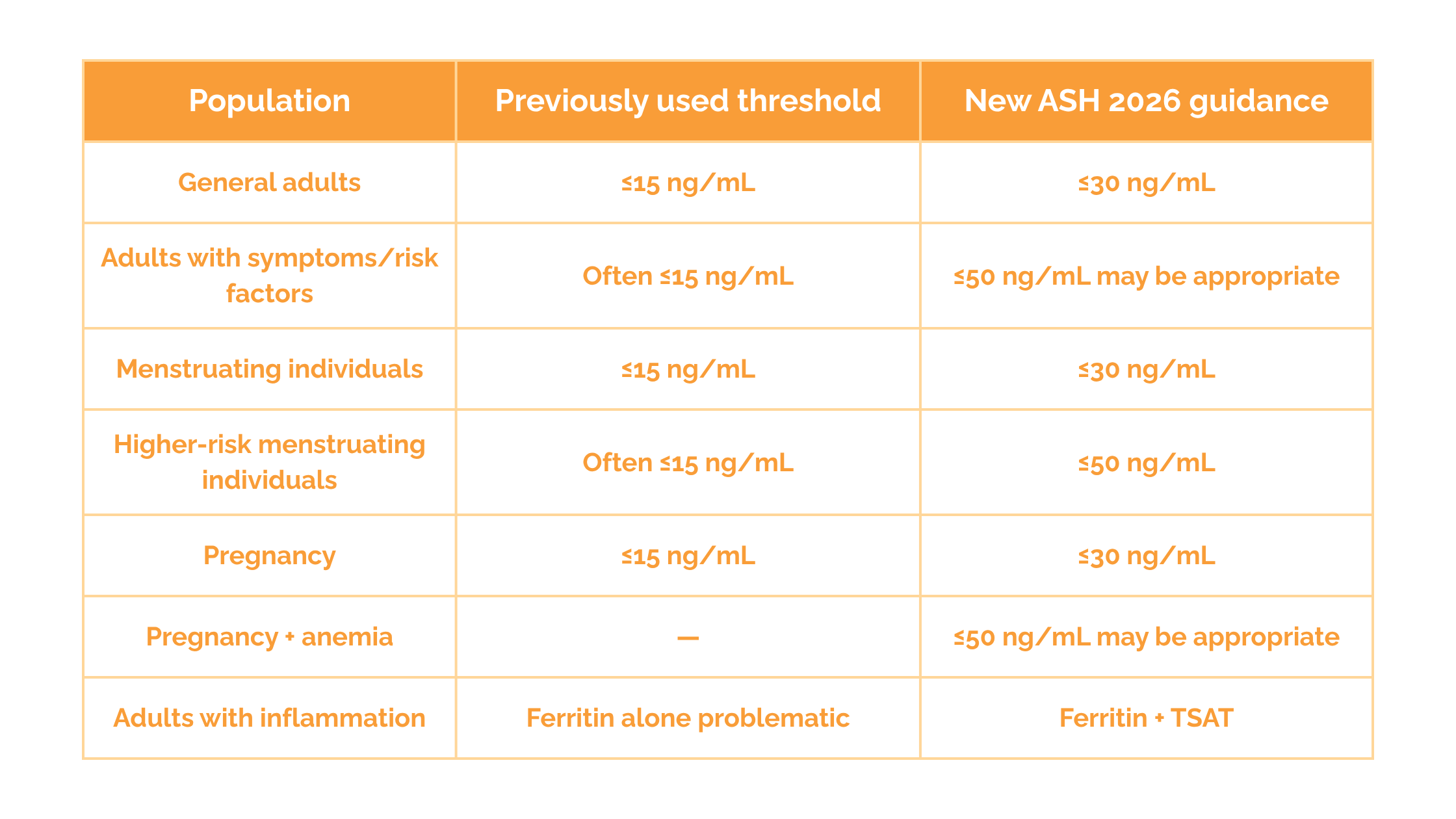
Previous cutoffs varied by lab and clinician, and ≤15 ng/mL is the figure that was widely used. For young children (9 months to 4 years), ASH suggests ≤20 ng/mL.
Why This Is a Bigger Deal Than a Change in a Lab Number
Iron deficiency develops in stages:
Iron stores decline → iron deficiency → eventually, in some people, hemoglobin falls → iron-deficiency anemia
Traditional clinical attention has often centered on the final stage. ASH's new guideline explicitly addresses iron deficiency with or without anemia, which supports earlier identification. It also confirms something many patients have lived: you can have a normal hemoglobin and still have low iron stores. Iron supports oxygenation of tissues and energy metabolism, so low stores can matter well before hemoglobin moves.
“But My Iron Level Was Normal…”
Serum iron and ferritin tell you different things. A typical iron panel includes several biomarkers, and each one answers its own question:
Serum iron: iron circulating in the bloodstream at the time of the test
Ferritin: a marker used to assess iron stores
Hemoglobin: reflects the oxygen-carrying component of red blood cells
TSAT (transferrin saturation): helps assess how much circulating transferrin is carrying iron
Why a single “normal” result can be misleading
Serum iron rises and falls through the day and shifts after meals or an iron-containing supplement, so one reading is a snapshot. Hemoglobin tends to be one of the last markers to change, because the body protects red blood cell production for as long as it can by drawing on its stores. Ferritin reflects those stores, which is why it often shows the earliest signal.
Ferritin can also rise with inflammation, which can hide low stores. That is the reason ASH pairs it with transferrin saturation in people with inflammatory conditions.

Your Lab Report Can Say “Normal” Even When ASH Says “Iron Deficient”
A lab's reference range describes where most results in a population fall. It does not describe the level where your body works best. Some labs list a lower limit for ferritin in the low teens, so a result of 22 can print without a flag. Under ASH's updated threshold of ≤30 ng/mL, that same result meets the criteria for iron deficiency, which a clinician would interpret alongside your symptoms and history.
“Normal” is not always the same as “optimal”
This theme shows up across bloodwork. Thyroid markers, vitamin D, B12, and ferritin all have ranges built to detect disease, which leaves little room to notice early shifts. Looking at where you sit within a range, and how that matches how you feel, adds useful information.
The Ferritin Threshold Has Moved From 15 to 30—and Sometimes 50
Why 30 ng/mL matters
A cutoff of 15 ng/mL identifies people whose iron stores are close to empty. A cutoff of 30 ng/mL identifies iron deficiency earlier, while stores are low but still present. That earlier window is where nutrition, diet changes, absorption support, and iron supplementation (when appropriate) can make the biggest difference before anemia develops.

When ASH Says Ferritin Up to 50 May Matter
ASH identifies situations in which a ferritin of up to 50 ng/mL may be appropriate as the cutoff. These include:
Symptoms associated with iron deficiency
Ongoing risk factors
Heavy menstrual bleeding
Abnormal uterine bleeding
Additional risk factors, such as gastrointestinal conditions, dietary restrictions, ongoing blood loss, or other chronic health conditions
Upcoming surgery
Pregnancy planning
Pregnancy with anemia
Menstruation and pregnancy deserve special mention. Both raise iron needs, and both are times when stores can fall quickly.
What Symptoms Can Occur With Iron Deficiency?
ASH lists fatigue, weakness, dizziness, difficulty concentrating, shortness of breath, rapid heartbeat, headache, and pale skin among the common presentations. Many people also describe hair shedding, restless legs, and feeling cold, though these have many possible causes.
Iron deficiency symptoms without anemia
Symptoms do not wait for anemia. In a randomized trial of women with unexplained fatigue, normal hemoglobin, and a ferritin at or below 50 µg/L, iron supplementation reduced fatigue compared with placebo (Verdon et al., 2003). Because fatigue has many potential causes, ferritin is one piece of a larger workup.

Why Functional Medicine Has Been Looking Beyond “Normal” for Years
In many functional and integrative medicine practices, this broader view of iron status has been part of the conversation for years. The new ASH guidelines bring conventional diagnostic criteria closer to that clinical approach.
The approach goes a step further than a single number. Ferritin, TSAT, hemoglobin, inflammation markers, and symptoms are read together, and the next question is always why iron is low. Diet, absorption, menstruation, gut health, and medications all belong in that conversation.
What the New Guidelines Don't Mean
Doesn't mean everyone needs iron supplementation. Iron can cause side effects, and too much is harmful for some people. The decision belongs with your clinician.
Doesn't mean higher ferritin is always better. Elevated ferritin can reflect inflammation, liver or metabolic conditions, or iron overload, so context matters.
Doesn't mean ferritin should be interpreted by itself. It works best alongside hemoglobin, TSAT, inflammation markers, and your symptoms.
Doesn't replace looking for the cause. Low iron has a reason, such as blood loss, low dietary intake, poor absorption, or increased demand.
The Bigger Lesson: Don't Wait For Anemia
Anemia is not the starting point of iron deficiency, but it can be a later consequence. Waiting for hemoglobin to drop means waiting for the last stage of a process that began earlier. If you have persistent fatigue, brain fog, or other symptoms and your bloodwork has been called normal, ask whether ferritin was checked and what the number was. Bringing the actual value to your appointment gives you and your clinician something specific to work with.
This article is for educational purposes and does not replace individualized medical advice.
Summary
The American Society of Hematology's 2026 guideline raises the ferritin threshold for diagnosing iron deficiency in most adults from 15 to 30 ng/mL, with 50 ng/mL possibly appropriate for people with symptoms or higher-risk situations such as heavy menstruation or pregnancy with anemia. Iron deficiency can exist alongside a normal hemoglobin and a clean lab report, so anemia marks a late stage. Ferritin works best next to transferrin saturation, inflammation markers, symptoms, and a search for the cause. If fatigue persists despite normal bloodwork, bring your ferritin number to your next appointment.
References
American Society of Hematology. (2026). American Society of Hematology 2026 guidelines for the diagnosis of iron deficiency. Blood Advances. https://doi.org/10.1182/bloodadvances.2025015950
American Society of Hematology. (2026, September 16). ASH sets new standards for diagnosing iron deficiency [Press release]. https://www.hematology.org/newsroom/press-releases/2026/ash-sets-new-standards-for-diagnosing-iron-deficiency
Camaschella, C. (2015). Iron-deficiency anemia. New England Journal of Medicine, 372(19), 1832-1843.
Verdon, F., Burnand, B., Stubi, C. L., et al. (2003). Iron supplementation for unexplained fatigue in non-anaemic women: Double blind randomised placebo controlled trial. BMJ, 326(7399), 1124.
World Health Organization. (2020). WHO guideline on use of ferritin concentrations to assess iron status in individuals and populations. World Health Organization.
